
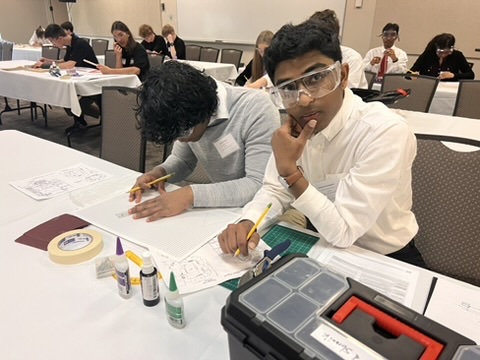
To Guide Delaware's Future Workforce
Support Every Learner with Career-Connected Instruction
Delaware Pathways helps educators bridge education and employment by offering students high-quality Career and Technical Education (CTE) Programs of Study. Whether you’re starting a new pathway or enhancing an existing one, you’ll find the tools and support to prepare students for meaningful postsecondary success.
CTE educators in Delaware are part of a statewide system recognized as a national model. Your work connects students to career opportunities, industry credentials, and real-world experiences that change the trajectory of their lives.
Understanding State and Local Models of Career Pathways
State Model:
- Curriculum developed by Delaware DOE
- Standardized assessments and credentials
- State-supported professional development and work-based learning integration
- Scalable solutions with consistent statewide quality
- Requires DOE approval through the CTE application process
Local Model:
- Designed by local education agencies to address specific community and industry needs
- Must align with DOE policy, quality standards, and Perkins V requirements
- Encourages innovation while maintaining rigorous outcomes
- Requires DOE approval through the CTE application process
How to Apply to Offer a Program of Study
To offer any CTE Program of Study, whether state or local, schools must apply through the Delaware Department of Education. The application process ensures programs meet quality standards, align with industry needs, and serve students equitably.
Click below for application templates, quality standards, deadlines, and DOE policies and procedures to guide a successful submission.

WHY IT MATTERS
Career Pathways Drive Student Success
- Students in CTE pathways graduate at 97.8%, nearly 9 points above the statewide average
- CTE connects classroom instruction to real career opportunities
- Students earn industry credentials and early college credit
- Work-based learning gives students hands-on professional experience
- Educators help students build networks with employers and mentors
02
CTE OUTCOMES (SY 2023-2024)
Results That Demonstrate Impact
- 97.8% of CTE concentrators and completers graduated on time
- 19.3% of CTE students earned an industry-recognized credential
- 22.91% of CTE students participated in work-based learning
- 74,681 total CTE participants in grades 7-12
- 9,579 students active in Career & Technical Student Organizations
EDUCATOR RESOURCES
Tools for Your Classroom and Program
Professional Development
Professional Development and Teacher Support
Delaware invests in the educators who make career pathways work. Opportunities include:
SREB Literacy Integration: In partnership with the Southern Region Education Board, Delaware CTE teachers embed literacy skills into pathway lessons using hands-on instruction. This strengthens students’ ability to analyze, solve problems, and apply knowledge for both academic success and workforce readiness.
CTE Cadre: A statewide professional learning community that keeps educators connected. The CTE Cadre Newsletter delivers regular updates, program highlights, and resources directly to your inbox.
Teacher Academy Pipeline: Delaware’s Teacher Academy CTE pathway prepares future educators through classroom learning and work-based experiences. If your school is interested in growing the educator pipeline, the Teacher Academy pathway offers a model for developing the next generation of teachers.
Environmental Literacy Integration: Delaware is embedding environmental literacy and climate readiness across all CTE programs. Professional development resources are available to help educators incorporate these themes into existing pathway instruction.

Middle Grades CTE
Building the Foundation in Middle School
Career exploration starts in middle grades. Delaware’s vision for middle school CTE is strong, equity-focused, and well-rounded programming that is open and available for all students to explore, grow, and learn before making decisions about high school and postsecondary plans.
The Middle Grades Initiative, developed in partnership with Education Strategy Group and Rodel, established a framework for quality middle school career exploration. The initiative identified three core beliefs:
- Clear and aligned expectations for high-quality middle school programming across all agencies in Delaware
- Increased local capacity for implementation and integration of middle school career exploration in all communities
- A shift in data culture that enables continuous monitoring and improvement at state and local levels
In SY 2023-2024, 83.54% of middle school students were enrolled in a CTE course. The goal is to reach 96% by SY 2028-2029.
Educator FAQ
State model programs use DOE-developed curriculum with standardized assessments and credentials. Local model programs are designed by districts to meet specific community needs but must still align with DOE policy and Perkins V requirements. Both require DOE approval.
All programs must be approved through the Delaware Department of Education’s CTE application process. Visit the DOE website for application templates, quality standards, deadlines, and procedures.
Delaware offers SREB literacy integration training, the CTE Cadre professional learning community, environmental literacy resources, and pathway-specific professional development. Contact CTE.STEM@doe.k12.de.us for current offerings.
Work-based learning is an integral part of every CTE Program of Study. Students document experiences through the Work-Based Learning Practicum course. The Daneisha Allen at Delaware Technical Community College coordinates placements and supports CTE teachers and WBL coordinators.
Students can earn industry-recognized credentials aligned with their career cluster. These are prioritized based on alignment with middle- and high-skill, middle- and high-wage, in-demand occupations. A full list is available at pages.delawarepathways.org/credentials.